
Endangered Artifacts
TORTOISESHELL COMB

Rarely do we take the time to consider how our consumer habits create broader implications that extend well beyond the initial financial impact to our wallet. However the popularity of a decorative material almost led to the extinction of one marine animal, the sea turtle. Despite being utilized for thousands of years, tortoiseshells became a highly coveted material from the 17th and 20th century. The durability, malleability, and beautiful patterning made it a sought after material, and artisans from around the world used tortoiseshell in decorative arts like jewelry, hair ornaments, eyeglass frames, buttons, and decorative inlays in furniture. (Tortoise refers to land turtles when talking about taxonomy, but in decorative arts it is applied to all types of turtle scutes). Evolving European fashions during the 17th century brought about the popularity of tortoiseshell hair combs as fashionable accessories for the elite.
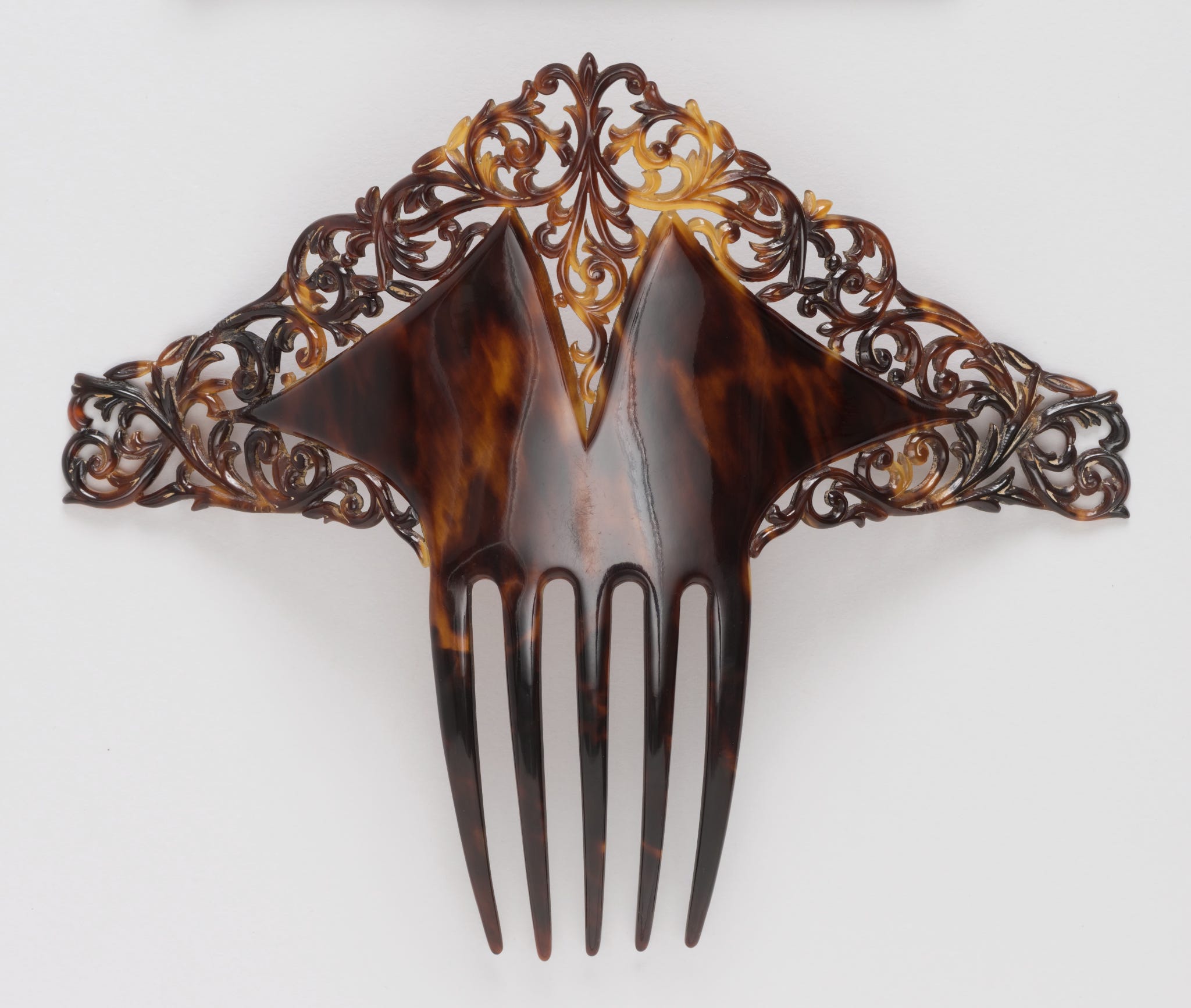
Tortoiseshell combs were fashionable around the globe for the wealthy elite. During the Victorian and Gilded Ages, women’s fashions shifted from narrow silhouettes to broad skirts and large sleeves. Consequently, women began styling their hair into elaborate voluminous updos, crowning the look with delicate combs used to secure hair and serve as an embellishment. In Spain, women who wore mantillas (silk lace veils) would place large tortoiseshell combs (peinetas) underneath to lift the veil up, showcasing it. In Japan, a decorative comb (kushi) made of tortoiseshell was a focal point of geisha and aristocratic hairstyles. All around the world, women of wealth were wearing tortoiseshell combs as decorative symbols of their social status.


Historically, artisans crafted combs from materials like ivory and tortoiseshell from the hawksbill sea turtle. The hawksbill is one of seven species of sea turtle, and the most recognizable by its mottled amber, yellow, brown, and black shell. Its decorative shell made it the most sought after of all of the species of turtles. Artisans valued tortoiseshell for its versatility. The material could be carved or molded using heat, then inlaid with precious stones, gold or silver. Once it cooled, it was sturdy and retained its shape.
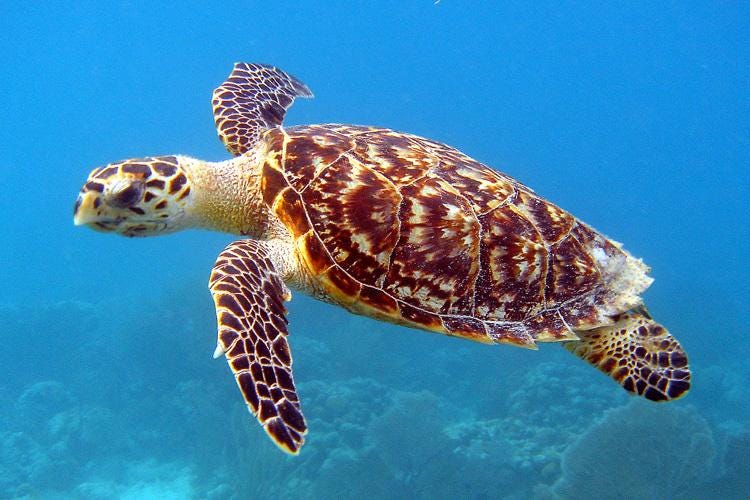
Shells are composed of keratin plates (scutes), and although aquatic turtles like the hawksbill naturally shed their scutes as they grow, this slow process couldn’t meet the growing demand, leading to the hunting of the species for their shells. The global production of tortoiseshell combs, as well as other decorative arts, drove the widespread hunting of hawksbill sea turtles. A recent research paper published in the journal Science Advances, demonstrates how vastly devastating the sea turtle trade has been. After mining historical data, researchers found that the scale at which hawksbills were exploited was greater than previously thought, and new data suggests around 9 million were killed for their shells. “The endangered hawksbill sea turtle (Eretmochelys imbricata) has been traded internationally perhaps longer and more intensively than any other marine species.”1 Trade of tortoiseshell went unregulated until the Convention of International Trade of Endangered Species of Wild Fauna and Flora (CITES) banned international trade of hawksbill sea turtles in 1977. They are currently listed as endangered and there are estimated between 8,000 and 23,000 nesting female hawksbill sea turtles left worldwide.
It wasn’t until the 1860s when another option was presented, celluloid. A simulated tortoiseshell began to be produced using the first commercially synthetic plastic. This discovery occurred when a young scientist, John Wesley Hyatt, saw an advertisement in a newspaper with a $10,000 reward for anyone who could invent a substitute for ivory to be used in billiard balls. Celluloid was not only able to be used for the intended purpose, but other consumer goods as well. What began as a promising step toward animal conservation, ultimately paved the way for an ecological nightmare.
During World War II, plastics were utilized as a substitute for natural materials that were scarce during wartime. Within a decade plastic was being mass produced for everyday consumer goods. Plastic pollution not only affects the hawksbill sea turtle, but all marine life. In an ironic twist, what was once a hopeful invention to save wildlife from overexploitation has become one of the greatest threats to their survival. If human demand has the power to reshape ecosystems for the worse, our conscious choices have the power to heal them. By rethinking what we buy, support, and value, we can transform our role from contributors to protectors.
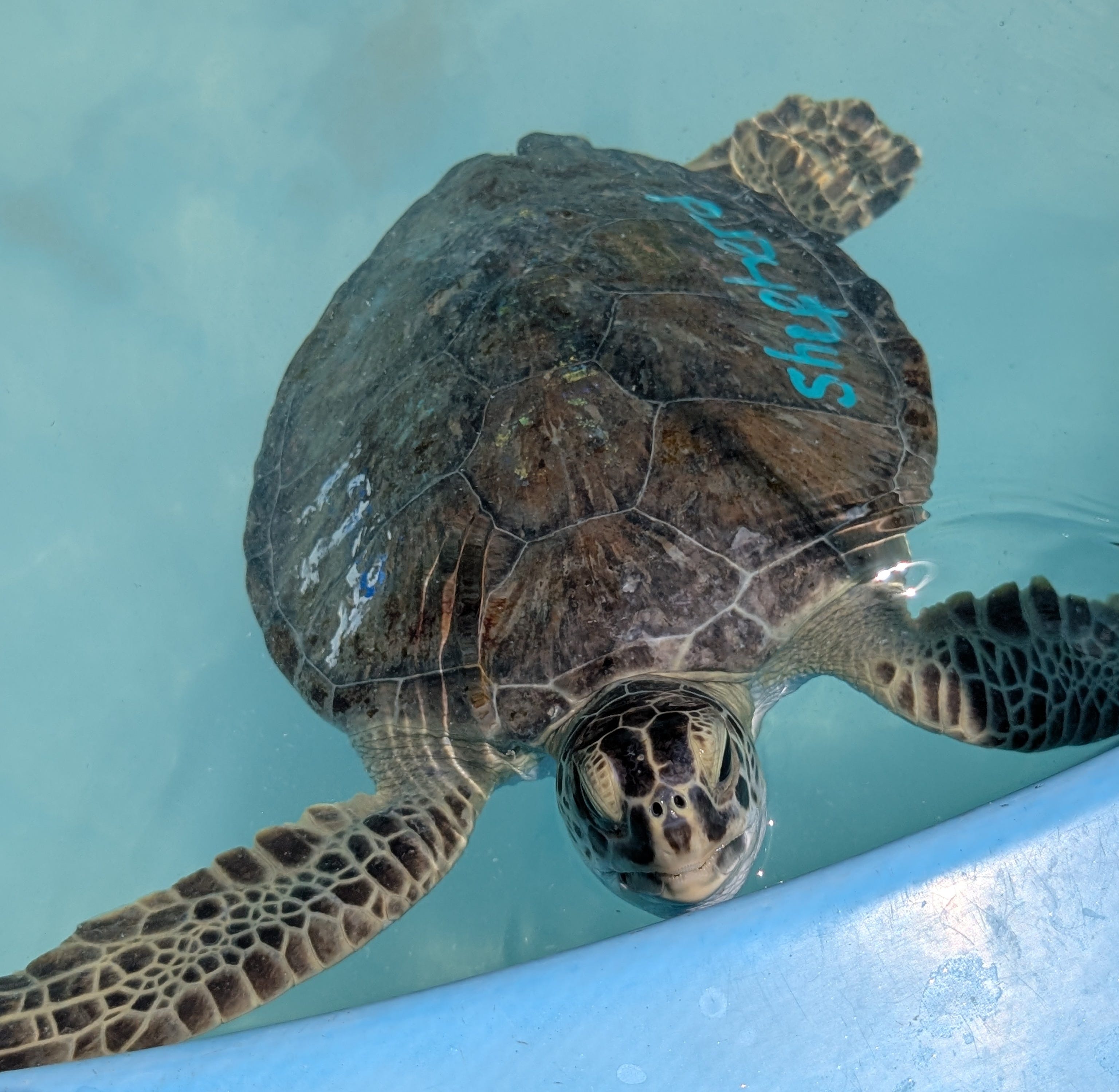
I was inspired to write this post after a recent trip to Florida. I visited The Turtle Hospital in Marathon, a rescue, rehab, and release facility. I witnessed the hard work being done to help sea turtles afflicted by consumption of ocean debris, entanglement, boat strikes, predator attacks, environmental distress, and tumors. Check out their website and learn how you can make a difference.
“No one will protect what they don't care about; and no one will care about what they have never experienced" - David Attenborough
Every great cabinet grows through shared discovery. If there is a particular object, collector, or hidden history you’re curious about, leave a suggestion in the comments! To learn more about my work and the person behind the collection, come say hello at laura-e-smith.com.
Discover More:
NOAA Fisheries, “Hawksbill Turtle.” N.D., https://www.fisheries.noaa.gov/species/hawksbill-turtle.
World Wildlife Fund, “Hawksbill Turtle.” N.D., https://wwf.panda.org/discover/our_focus/wildlife_practice/profiles/fish_marine/marine_turtles/hawksbill_turtle/.
Nahill, Brad, “Trade in Hawksbill Shell Still Active Globally.” The State of the World’s Sea Turtles (SWOT), June 16, 2021, https://www.seaturtlestatus.org/articles/swot-report-16-trade-in-hawksbill-shell-still-active-globally.
Miller, E.A., McClenachan, L., Uni, Y., Phocas, G., Hagemann, M. E., & Van Houtan, K. S., “The historical development of complex global trafficking networks for marine wildlife”. Science Advances, 2019, https://www.science.org/doi/10.1126/sciadv.aav5948.